

How to Book a Millinery Consultation With Confidence
- judybentinck
- 7 days ago
- 6 min read
A remarkable hat begins well before the first fitting. It begins with an occasion, an outfit, and a clear sense of how you wish to feel when you enter the room. Knowing how to book a millinery consultation allows enough time for those details to be considered with the care a couture headpiece deserves.
For a wedding, Royal Ascot, an investiture, or a formal celebration, an appointment is your opportunity to turn a beautiful idea into a considered, wearable design. The process is personal, but it need not feel complicated. Arrive prepared, book at the right point in your event planning, and allow your milliner the space to create something exceptional.
When to Book a Millinery Consultation
Timing is the first luxury. For a bespoke commission, it is wise to arrange your consultation as soon as your outfit is selected or the fabric has been chosen. This gives the design room to develop naturally, from silhouette and color through to hand-finished details and final fittings.
For major summer occasions, particularly weddings and race-day events, appointments are often in demand several months in advance. Aim to book four to six months before your event where possible. This is especially valuable if your look requires precise color matching, a custom-dyed trim, or an entirely original shape. If you are traveling to London from elsewhere in the UK or the US, early planning also makes it easier to coordinate appointments with your schedule.
A shorter lead time may still be possible for a ready-to-wear piece or a design that requires only minor styling adjustments. It depends on the season, the complexity of the commission, and the milliner's current workroom schedule. A consultation is the best place to establish what can be achieved beautifully within the time available.
What to Have Ready Before Your Appointment
You do not need a finished fashion brief to meet with a milliner. A few thoughtful references, however, make the conversation far more productive. Bring photographs of your outfit, fabric swatches if you have them, and an image of the shoes and bag you expect to wear. If your dress is still being made, a sketch or an accurate description of the neckline, shoulder line, and fabric finish will be useful.
Your event details matter just as much as the clothing. A church wedding calls for different considerations than a garden reception; a full day at Ascot has different practical demands than an evening gala. Mention the venue, date, start time, dress code, and whether you expect to be outdoors. Wind, travel, photography, and the duration of the day all influence the most elegant choice of scale, structure, and securing method.
It is also helpful to arrive with an honest idea of what you do and do not wear comfortably. Some clients love the presence of a broad brim. Others prefer the lightness and polish of a sculptural cocktail hat or percher. There is no need to force yourself into a style that feels unfamiliar simply because it looks dramatic on someone else. Couture millinery should create poise, not require endurance.
How to Book a Millinery Consultation for Your Occasion
When you make an inquiry, share the event date, location, and the kind of piece you are considering. Include whether you are seeking a fully bespoke design, a tailored version of an existing style, or guidance on selecting from a ready-to-wear collection. This allows the studio to recommend the most suitable appointment and advise on lead times from the outset.
Be clear about the role your hat will play in the overall look. A mother of the bride may want a piece with authority that remains graceful through an emotional, full-day celebration. A wedding guest may be looking for a distinctive finishing touch that complements rather than competes with the dress. A bride may require a headpiece that feels ceremonial in the day and can be adapted for the reception. Each intention leads the design in a different direction.
If you have a budget in mind, it is entirely appropriate to discuss it at the beginning. Bespoke millinery reflects the materials, handwork, design complexity, and time required in the workroom. An open conversation helps your milliner propose the right route, whether that is a custom couture commission or an exquisite ready-to-wear design styled to your outfit.
At Judy Bentinck, consultations are approached as an exchange of ideas and expertise: the client brings the occasion and her personal style, while the milliner brings an understanding of proportion, construction, and the quiet impact of a beautifully resolved silhouette.
What Happens During the Consultation?
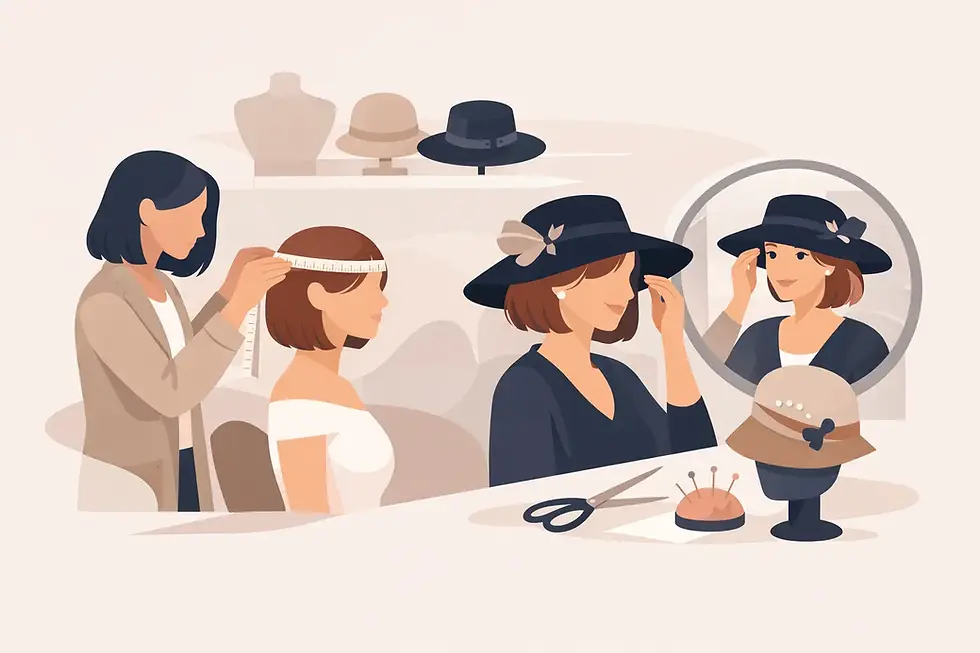
The first appointment is a design conversation, not a test of your fashion knowledge. Your milliner will consider the proportions of your outfit, your hairstyle, face shape, height, and the visual balance of the complete ensemble. You may try different bases, brims, and placements to discover what feels most natural.
This is where small distinctions become significant. A headpiece angled slightly forward can create a more intimate, romantic effect. A piece placed higher on the head may feel more formal and elongate the silhouette. A sweeping brim can frame the face beautifully, but its scale must suit both the wearer and the setting. The most successful choice is not necessarily the most elaborate one. It is the one that appears entirely at ease on you.
Color is another central part of the discussion. Exact matching can be exquisite, particularly for ceremonial dressing, but it is not always the only answer. A tonal shade can add depth to a single-color outfit, while a considered contrast may bring life to a print or a neutral palette. For US clients attending British-style events, this can be especially useful: the goal is polished coordination, not a costume-like match.
Expect to discuss hair as well. Bring or describe your intended hairstyle if you can. An updo, loose waves, and a sleek low bun each affect placement and the choice of fastening. The design should remain secure without compromising comfort, whether it is held with a headband, comb, elastic, or discreet millinery wire.
The Difference Between Bespoke and Ready-to-Wear
A bespoke commission is designed around you and your occasion. It offers the greatest freedom in shape, materials, color, trim, and fit. It is the ideal choice when your outfit has a specific color or unusual fabric, when the event carries particular significance, or when you wish to wear a piece that is entirely your own.
Ready-to-wear millinery offers a different kind of pleasure: the confidence of selecting a finished designer piece with a defined point of view. It can be an excellent option for clients working to a closer date or those who fall in love with a collection design as it is. In some cases, a ready-to-wear piece can be styled with your outfit and adjusted for secure placement, giving you a highly personal result without the lead time of a full commission.
Neither approach is inherently more appropriate. The decision rests on timing, the importance of precise customization, and whether the piece must answer to one particular outfit or become a versatile part of your occasionwear wardrobe.
Preparing for Your Fitting and Event Day
Once your design is underway, keep your outfit, shoes, and accessories consistent where possible. Changes to a neckline, hair color, or dress shade can alter the balance of the finished look. If you need to make a substantial change, tell your milliner promptly so it can be considered before the final fitting.
At the fitting, wear your intended hairstyle or bring clear references for it. Take time to move naturally, look down, turn your head, and sit. A couture hat should feel secure enough that you forget the mechanics of wearing it, while retaining its immaculate line. Ask how to place it yourself if you are traveling or dressing without assistance on the day.
Store the piece in its box until the event, away from moisture, direct heat, and crowded closets. Carry it carefully rather than wearing it during a long car journey. These small gestures preserve the shape and finish that give millinery its distinction.
The finest consultation does more than produce a hat that matches a dress. It gives you the assurance that every detail has been designed for your entrance, your photographs, and the particular importance of the day ahead.


Comments